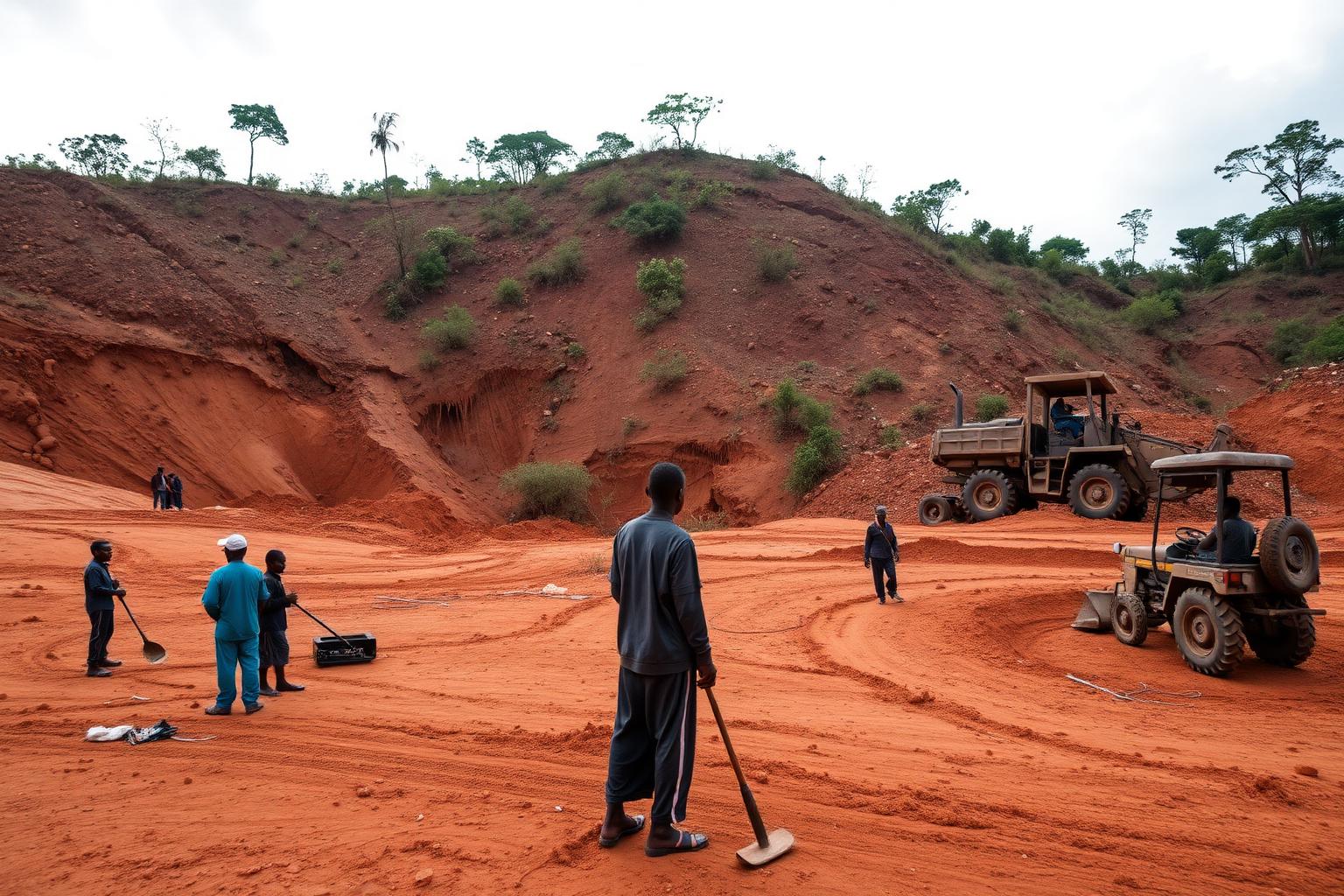
More than 100 people died last Tuesday when an artisanal goldmine in the village of Zamboye, in western Central African Republic, caved in after a landslide. The site lies about 50 kilometres from the town of Baboua, close to the Cameroonian border. Footage verified by news agencies showed an avalanche of sand descending on the miners working below. A local prosecutor said the collapse of several underground tunnels was the likely cause, and a Red Cross volunteer involved in the relief effort told the Associated Press that more than 100 bodies had been recovered, a figure confirmed to Reuters by a senior official at a local mining association.
The miners were believed to be nationals of CAR and Cameroon, and Cameroon's Eastern region governor said at least three of his country's citizens were among the dead. Rescue work has been slow and hazardous. Local reporting noted that tractors brought in to shift the earth risked burying any survivors still alive underneath, and the exact number of people underground when the tunnels gave way remains unknown. A member of the Zamboye youth council said the toll was expected to rise.
Not an isolated event
At least 40 people had already died in mining incidents in CAR this year before Zamboye. The pattern is consistent across the region: unregulated sites, shafts dug without shoring, and no enforced safety standard, because the sites themselves sit outside the law. Regulations criminalising informal mining exist in much of the continent, but enforcement does not follow, and unemployment keeps drawing workers to abandoned and informal diggings. When a collapse happens, there is no site register to count the missing against, which is why death tolls in these events stay approximate for days.
These are not accidents in the way the word is usually meant. They are the predictable output of an unregulated industry.
What formalisation would actually require
The policy response, formalisation, is well rehearsed on paper: bring artisanal sites into a licensing system, attach basic safety requirements to the licence, and give miners a legal route to sell what they dig. The difficulty is that formalisation asks for state presence in exactly the places where the state is weakest. Zamboye sits near a border, far from Bangui, in a country where the government's reach into mining areas has always been partial. Without inspectors, a licence is a document, not a safeguard.
There is a harder truth underneath. Artisanal mining persists not because miners misunderstand the risk but because the alternatives are worse. Young men and women went to Zamboye, as one local councillor put it, to save their families from despair. Safety follows economics. Any policy that ignores why people dig will keep counting bodies after landslides.
What we are watching
The final death toll once recovery ends, the investigation CAR authorities say has been opened, and whether the cross-border dimension of the site, with Cameroonian nationals among the victims, produces any joint response. More broadly, whether this disaster changes anything about how governments in the region treat artisanal gold: as a criminal problem to be suppressed, or as an industry to be made survivable.